


Industrial Tomography

Industrial tomography is non-destructive testing, an advanced technology that allows detailed three-dimensional images of an object to be obtained using X-rays .
This technique is critical for the analysis and verification of components and their material (material tomography), allowing detection of defects, inclusions, and porosity that would otherwise be invisible.
Industrial tomography, or industrial computed tomography, is widely used in various industries, such as automotive (automotive tomography) and aerospace, to ensure the quality and reliability of components.
At our industrial tomography center, we can perform tomographic analysis and obtain a tomographic scan that allows us to perform dimensional analysis, defect analysis, and reverse engineering of the analyzed component.
Industrial computed tomography: the laboratory
TEC Eurolab’s industrial computed tomography center supports companies in the acquisition and interpretation of X-ray scans of industrial components, enabling in-depth product analysis and evaluation of possible defects.
Using tomographic scans, we can perform several types of analysis:defect analysis, which allows us to detect defects, inclusions and porosity in materials;dimensional analysis, which verifies the dimensions and conformity of components to the technical drawing; and reverse engineering, which allows us to derive the CAD model from the physical component.
Industrial computed tomography is also optimal for FAI (First Article Inspection), ensuring that the first production items meet all the specifications required at the design stage.
In addition, it is often used for whole-batch production inspections, ensuring consistent quality.
Our experience in industrial tomography, combined with the expertise of our technical staff in choosing the most suitable instrumentation, setting parameters, and interpreting tomographic scans, enables us to support the customer at all stages of the process, from prototype analysis to analysis on the finished component.
Discover the potential of CT Scan
The advantages of industrial tomography ndt
Industrial tomography has become a nondestructive technology now indispensable in the quality control of major industries.
Using industrial computed tomography, detailed three-dimensional images of complex components can be obtained, allowing in-depth analysis without damaging the material and the component being scanned. An in-depth investigation of the component using tomographic scanning allows the identification of possible defects, enabling companies to envisage corrective actions before proceeding with the final production or marketing of the component.
Performing tomographic analysis means bringing together dimensional inspection and complete defect control in a single nondestructive analysis, enabling early detection of any critical issues, improving engineering confidence on the product and drastically reducing time to market.
What are the benefits for the customer?
– Strengthening control over the quality of their products.
– Supporting R&D departments during prototyping of new components.
– Checking in production for compliance.
– Reducing the time to search for causes of defects in a product.
What analysis can you do with industrial tomography and what results can you get?
In our tomography center, we offer a wide range of advanced services to meet the needs of different industries.
Below, the main types of analysis that can be performed by tomographic scanning will be explained.
Defect analysis
Following tomographic scanning of a component and reconstruction of the resulting tomographic volume, defect analysis allows the state of the component, without damaging it, to be defined in terms of:
Evaluation of internal discontinuities according to acceptability specifications and issuance of Accept/Reject judgment
Classification of discontinuities in terms of extent in the 3 dimensions, type and position with respect to the CAD of the component
Definition of the total volume occupied by the discontinuities with respect to the total volume of the component with the application of specific “Porosity” calculation modules
Import of the mathematical models of the component and verification of the removability of discontinuities detected during the processing phase for In-Process and Cost Saving controls
Dimensional analysis
Industrial computed tomography, in addition to applications in NDT (Non Destructive Testing), has high potential in the field of dimensional analysis.
Unlike standard measurement technologies, in fact, the X-ray traversal of all parts of the inspected sample allows reconstruction of the entire volume of the component (both external and internal surfaces). In this way, during the data analysis phase it is possible to perform measurements even on all those portions of the material normally precluded by a traditional inspection, unless the sample is sectioned making it unusable.
New product validation
The purpose of first-product validation is to give objective evidence that drawings, dimensions and all design specifications are verified and classified with theintent of bringing out any nonconformities in order to avoid their presence in mass production.
Tomographic inspection, thanks to both defectological and dimensional applications and the possibility of detecting both internal features (ducts, blind holes, internal circuits), enables accurate and reliable FAI characterization.
Aerospace, biomedical and automotive: tomography applied to industries
Industrial tomography has crucial applications in the automotive, aerospace, and biomedical sectors, where accuracy and quality of components are critical.
In the automotive industry, it has the ability to perform tomographic scans on critical components such as engine blocks, valves, injectors, electronic components, etc., and allows internal defects such as cracks, porosity or inclusions to be detected more immediately than other techniques, providing an overall picture of the material/component condition. This ensures that each part meets rigorous safety and performance standards. This type of nondestructive analysis is essential to prevent failures that could compromise vehicle safety.
In aerospace, industrial tomography enables accurate inspection of critical parts such as turbines, engine blades, and composite components, where accuracy is critical to flight safety and operational reliability. The accuracy of tomographic analysis allows the detection of micro-defects that could evolve into serious problems during flight. In summary, industrial tomography is essential for maintaining high standards of safety, reliability, and performance in aircraft and aerospace equipment.
In the biomedical industry, industrial tomography is used to ensure the quality and safety of medical devices, which often must meet extremely high standards. The ability to perform high-resolution scans allows implants and prostheses to be examined with micrometer precision, detecting defects that could compromise the functionality or biocompatibility of devices. In addition, the ability to analyze components made with additive technologies allows for continuous innovation and improvement of medical devices, ensuring that each product meets required specifications and is safe for clinical use.

Schedule a technical discussion with our NDT Manager
We will analyze your product specifications to define the most appropriate instrument setup and control plan to support your production.

Industrial computed tomography: comparing technologies in the inspection of high-density components.
How does the power of the source used affect the outcome of a CT scan?
In our Tomography Center, we compared the two most powerful systems (LINAC DIONDO D7 6MeV vs. NSI X7500 450 MeV) to scan a steel gear wheel and make both defectological and dimensional comparison of the outputs.
Want to read the full case study?
Technical characteristics of materials tomography
In order to perform industrial tomography, it is first necessary to know the purpose of the tomographic scan and the component to be analyzed.
In fact, if a component is large and composed of high-density alloys, probably only the LINAC will be able to obtain acceptable results. If, on the other hand, the purpose is to find small discontinuities, then it will be necessary to use the tomograph that allows the highest resolution to be achieved.
In general, based on these data, each scan requires making several considerations to set the many technical parameters needed to optimize the quality of the tomographic scan. These considerations, for example, are:
– Size and weight of the component: based on this data, the most suitable tomograph for the component will be chosen. At TEC Eurolab, we are able to scan components weighing up to 200kg and with a scannable volume equal to a cylinder with a diameter of 1.5m and a height of 4m.
– Material of the component: the most suitable tomograph will also be chosen based on this parameter. With the LINAC 6.0 MeV tomograph, we can perform tomographic scans on super alloy components.
– Fixing the component: the component during the scan must remain stationary, at this stage I have to ask myself: how do I fix it in such a way that it does not move during the movement of the various components of the tomographic system?
– Purpose of the scan: dimensional and/or defectological? What do I want to achieve?
From these considerations derive the subsequent “settings” of the system parameters, including
– Voltage (kV): determines the penetrative capacity of the photon beam through the object being analyzed, the greater the size and/or density of the material, the greater this value will have to be
– Current (uA): signal intensity that reaches the detector
– Resolution (µm): is the parameter on which the smallest detectable feature on a tomography image depends
– No. of projections: images that will be collected by the system to then reconstruct the tomographic volume
The stages of tomographic analysis
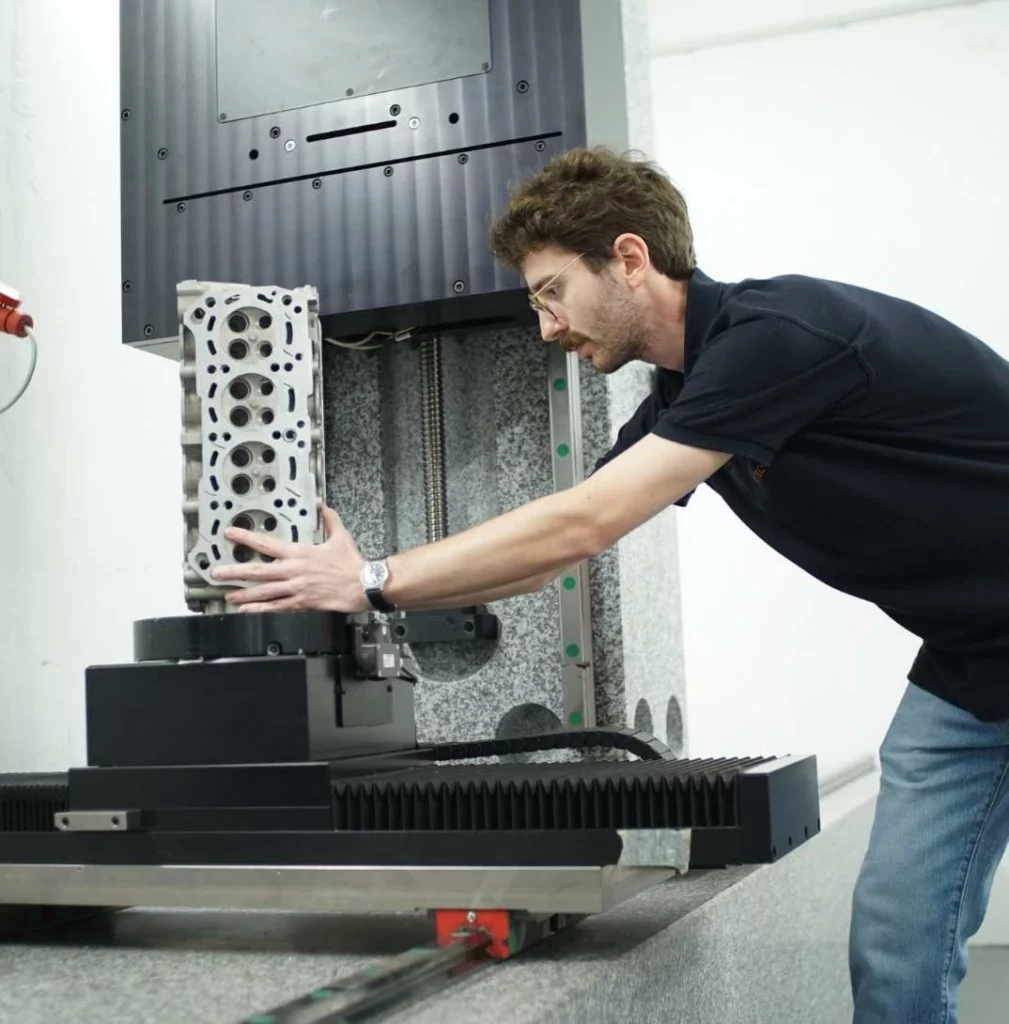
- Insertion of the component inside the industrial tomograph
- setting of scanning parameters
- scan initiation and data collection
- Reconstruction of the virtual volume of the component by the workstation
- analysis of the scan obtained with dedicated software
Tools of tomography
TEC Eurolab was a forerunner of this new analysis technology and the first tomographic laboratory in Italy to install this instrumentation in 2013.
Today we have three tomographic systems with different characteristics and potentials, from 240 Kv up to 6 MeV.
Learn in detail about the equipment in our tomography center.