


Ultrasonic inspection (UT)

What does the ultrasound (UT) method consist of?
Ultrasonic inspection, identified by the acronym UT, is applied by sending mechanical vibrations into a material and is capable of detecting volumetric discontinuities.
Theultrasonic wave, by causing the crystalline structure of the inspected material to vibrate, is able to obtain the response echo of any discontinuity located perpendicular to the direction of propagation of the UT beam.
Ultrasonic inspection is particularly suitable for searching for all those volumetric discontinuities that may not surface if sufficiently distant from it.
Where and when is ultrasound (UT) method control applied?
UT inspection is normally applied to materials having a crystalline structure (typically metallic materials), which is necessary for UT beam propagation. There are no particular restrictions about the material being inspected, except that the crystalline grain should not be of coarse size; this condition in fact causes scattering of the ultrasonic beam and loss of information from any discontinuities.
For metallic materials, typical products subject to inspection are forged products (in which discontinuities lie in precise planes), welded products, and semi-finished products such as bars or billets. UT inspection of metallic materials can also be carried out on cast components, but it is necessary to consider the geometric complexity of the component to define the limits of inspectability.
Do you want to check the quality of your product by the ultrasonic method?
Ultrasound control instrumentation (UT)
TEC Eurolab has eco-pulse instrumentation (A-SCAN representation) calibrated according to UNI EN ISO 22232-1 (formerly UNI EN ISO 12668-1) and ASTM E317.
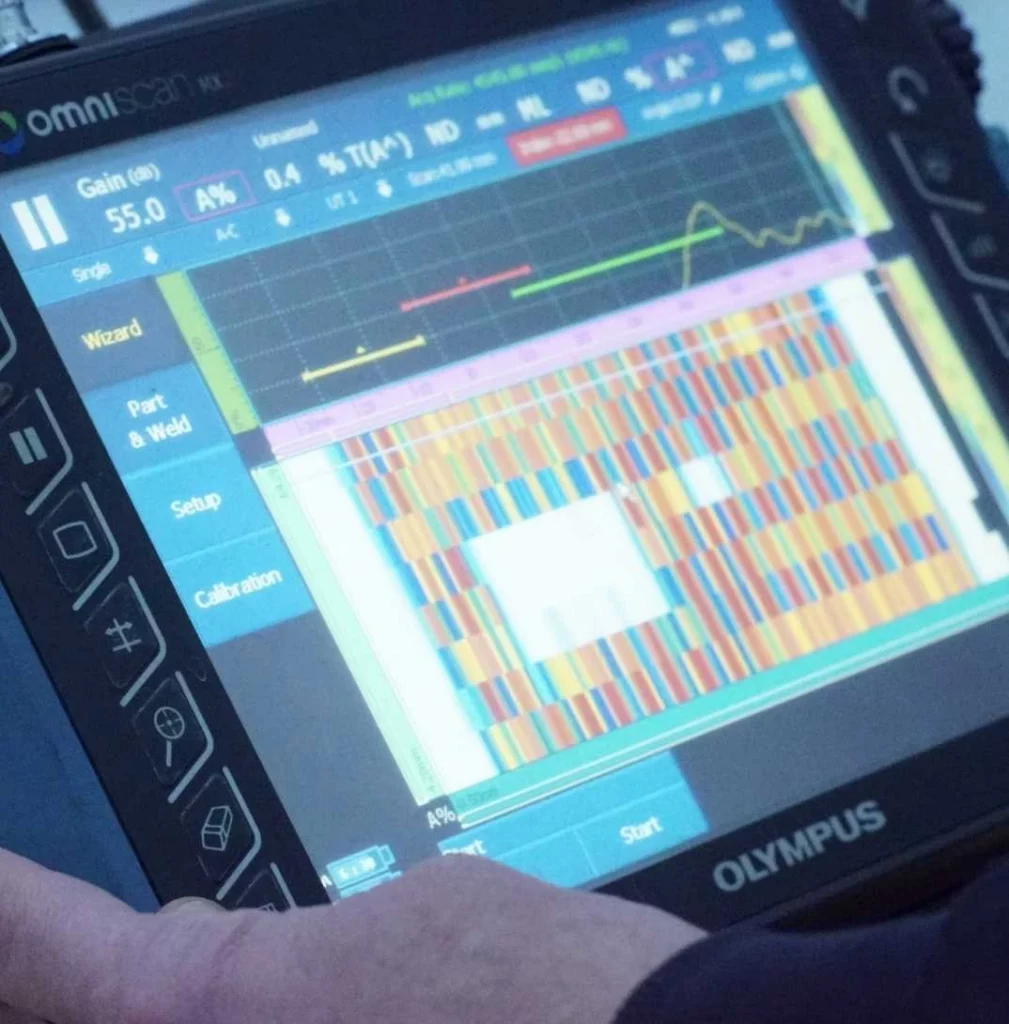
In the case of controls where a C-SCAN or B-SCAN representation is required, TEC Eurolab also has Phased Array instrumentation calibrated according to UNI EN ISO 18563, which can be used with probes moved manually, by trolley or directly installed on an immersion control system with 3-axis movement.
In addition to on-site applications, which are accredited by ACCREDIA 17025 in accordance with UNI EN SIO 16810, TEC Eurolab performs customer inspections for:
- Verification of welded joints in accordance with UNI EN ISO 17640
- Forged/forging verifications in accordance with UNI EN ISO 10228-3/4
- Verification of Castings in Accordance with UNI EN ISO 12680
- Thickness verifications on pressure equipment according to INAIL guidelines and in accordance with UNI EN ISO 16809