


Resilience Tests
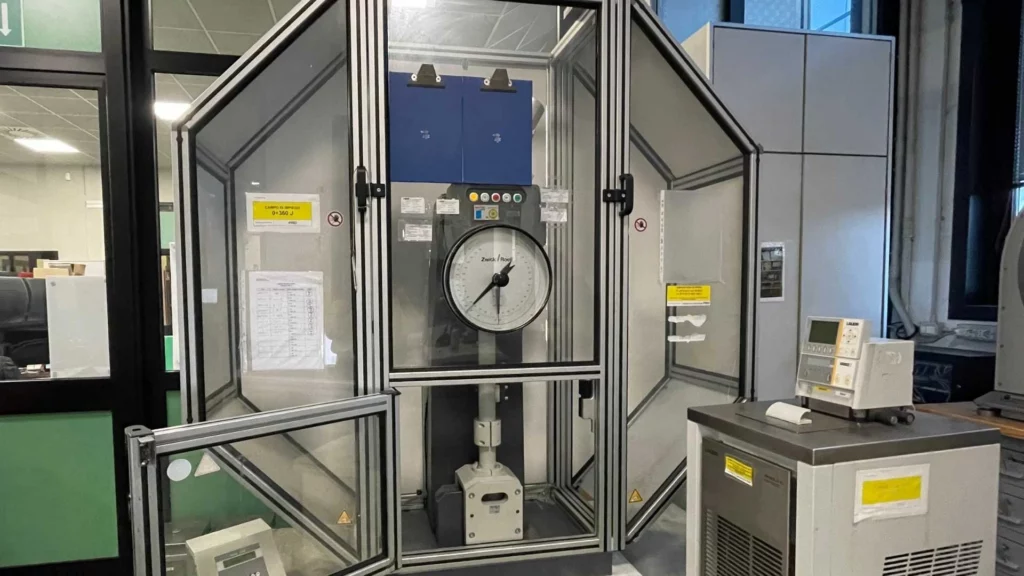
Resilience of materials is a fundamental property for evaluating a material’s ability to absorb energy before fracturing. Resilience tests make it possible to determine a material’s resistance to impact and dynamic stresses by simulating real-world conditions of use.
Resilience testing is a type of mechanical test that involves breaking a specimen with a single blow, using a pendulum (Charpy pendulum) that is used to measure the energy required for fracture.
Understanding the Charpy resilience of a material is essential to ensure its reliability under high stress and strain conditions. The results of these tests provide crucial insights into the selection of materials best suited for specific industrial applications, improving safety and performance.
Charpy resilience test: procedure and modalities
Resilience tests are performed through the use of the Charpy pendulum. The specimen, notched in its half, is placed horizontally on two supports and struck in the center at a free-falling pendulum. The pendulum is designed to ensure a controlled and repeatable impact. The initial energy of the pendulum and the residual energy after fracture of the specimen allow calculation of theenergy absorbed. This is measured in Joules and represents the impact resistance of the material(Charpy resilience). The main factor affecting resilience testing is temperature. In fact, the Charpy test can be performed either at room temperature or at low temperatures (as low as -70°C) to test the different behavior of the material as the environmental conditions in which it is found change.
Standards for resilience testing
The main standards to be followed for resilience testing of metallic materials are:
- UNI EN ISO 148-1
- ASTM E23
Ancillary regulations are then arranged:
- UNI EN ISO 898-1 Testing of Screws
- UNI EN ISO 9016 Resilience tests on welded joints.
- ASTM A370 Mechanical tests on steel
Standards define strict parameters to be met in performing a resilience test, specimen preparation, test conditions and acceptance criteria. The results of resilience tests are fundamental to the mechanical characterization of materials.
Understanding the strength of materials helps in the selection of the alloy for the manufacturing process, the decision of heat treatments and machining to be performed on the chosen material. These results then allow the quality of components to be improved, increasing their safety and reliability in critical industrial applications.
Resilience tests on materials and tools
Resilience tests are performed on awide range of metallic materials with a focus on structural steels, aluminum alloys, titanium and other materials used in high-risk industries such as aerospace and automotive.
The main tool used for these analyses is the Charpy pendulum, a device designed to strike the specimen with a predetermined energy and measure the amount of energy absorbed during fracture.
Charpy resilience tests make use of advanced technologies, including high-precision data acquisition systems and climate chambers to conduct tests at different temperatures. These tools enable accurate and reproducible results, which are critical for comparative material analysis. In some cases, Charpy’s pendulum resilience testing is supplemented with imaging techniques to study fracture morphology and delve deeper into material behavior.

Put your materials to the test with a Charpy strength test
Charpy test with TEC Eurolab
Relying on TEC Eurolab to perform resilience testing means choosing a laboratory with established experience in the analysis of static and dynamic mechanical properties of materials.
With instrumentation, advanced technologies and a team of qualified specialists, TEC Eurolab ensures that the material resilience test is performed according to the most stringent international standards, ensuring a detailed analysis of the energy absorbed by the material during fracture.
Charpy resilience testing carried out by TEC Eurolab supports companies in optimizing production processes, offering key data for selecting the most suitable materials for specific industrial applications. Choosing TEC Eurolab means having a reliable partner for Charpy resilience testing, with a precision-, safety- and customer-oriented approach that is essential to meet the challenges of the most demanding industrial sectors.