


Computed radiography
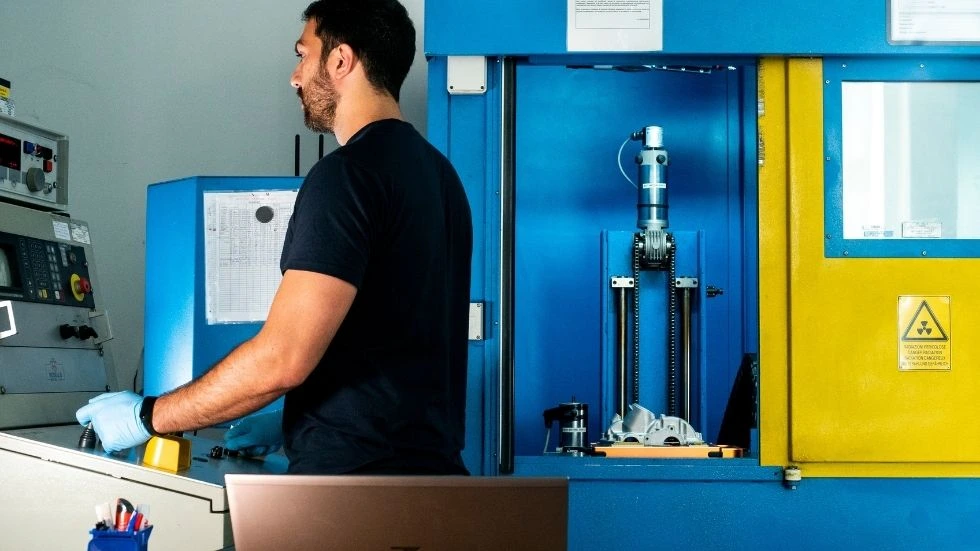
Computed radiography, also known as CR radiography, is an advanced imaging technique that uses X-rays to obtain detailed images of the internal structures of industrial components.
The use of film radiography is costly both in terms of the time required and the costs associated with the process.
The application of No Film (Computed Radiography) streamlines the process by providing the same coverage in fewer exposures , consequently reducing costs.
In the face of this reduction in exposures, the quality of control with CR radiography is still met through verification of the following parameters:
- signal to noise ratio (SNR)
- contrast-to-noise ratio (CNR)
level of quality achieved by IQI (wire or hole) - Verification of the basic spatial resolution (with double-threaded IQI)
- ease of use of information that can be sent via any digital system in its native format (DICONDE or TIFF).

Rely on advanced imaging technique
Advantages and benefits of computed radiography
Digitization of the radiographic image results in some substantial changes from classical radiography.
The main advantages of CR radiography are:
- The increase in laying latitude with the same parameters;
- digitization of the image and consequent ease of management/storage;
- The reduction of consumables;
- the reduced development exposure times and the possibility of image post-processing.
- Finally, it is possible to evaluate the detected discontinuities by means of an evaluation performed using digital atlases, containing different types of discontinuities with gradually increasing sizes.
Another significant benefit is the ability to easily store and share digital images, improving traceability and documentation of quality control. Compared with traditional techniques, computed radiography offers faster response times and greater operational efficiency.
The results obtained are significantly more intelligible than those obtained with the traditional technique, especially since the areas of detail often show defectology that traditionally cannot be detected.
Applications and industries involved
Computed radiography is a nondestructive testing methodology applicable to major industries such as automotive, aerospace and general industries.
With CR Radiography it is possible to make very precise measurements of detected imperfections or the component (linear point-to-point measurements, diameters and areas).
The CR system can also be used to assess the quality of welded joints, or for example in the field of castings it is very useful to obtain a complete picture in the various changes of casting sections, or in assembled components and electrical/electronic circuits it allows to define the precise positioning of inserts or connecting parts.
In the automotive and aeronautics sector this methodology is used with the purpose of assessing imperfections in composite materials, especially in fiberglass and carbon fiber.